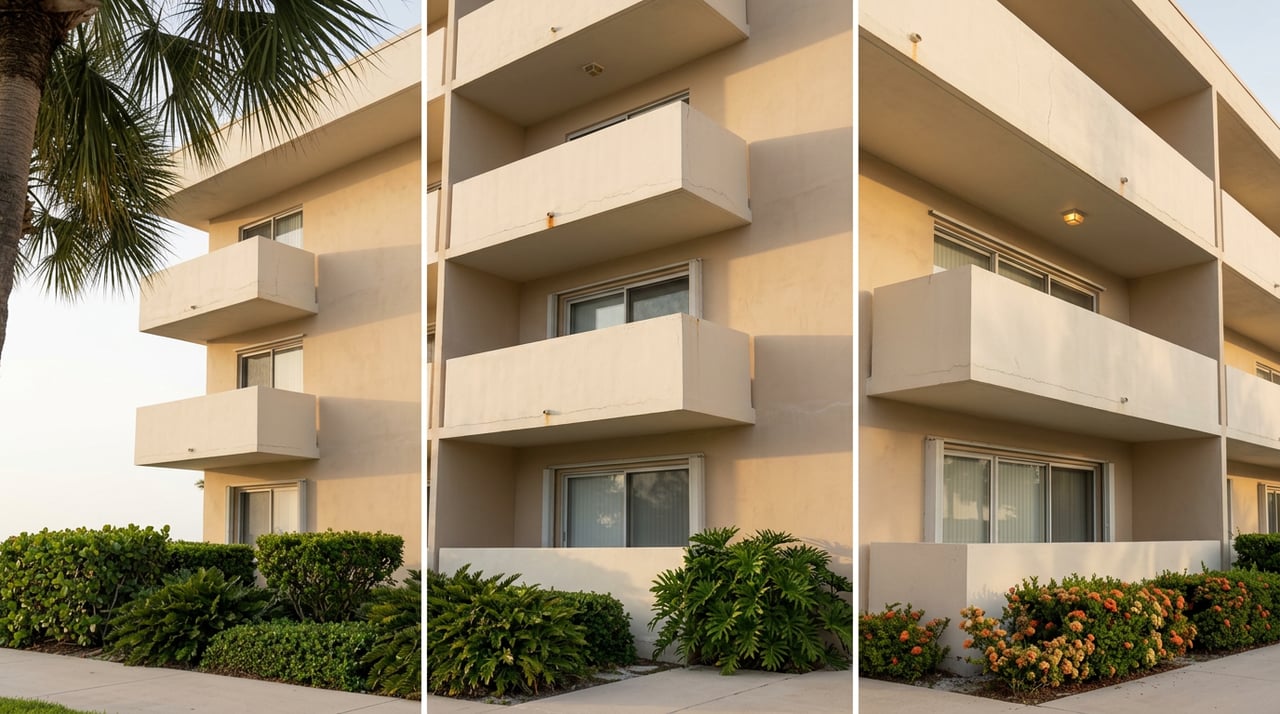
Miami Condo HOA Fees and Building Age Matter First
August 20, 2026
August 20, 2026
Two weeks ago, the rules changed for anyone financing a Miami condo with a conventional loan. As of August 3, 2026, Fannie Mae and Freddie Mac eliminated Limited Review, the shortcut that let lenders wave a large, seemingly healthy building through underwriting without a full look at its finances. Every condo loan application dated on or after that day now gets the full review: reserve funding, delinquency rates, insurance coverage, pending assessments, all of it.
If you're shopping for a Miami condo right now, that single date matters more than whichever neighborhood list you've been scrolling. Roughly 700 buildings across Miami-Dade, Broward, and Palm Beach counties are already sitting on Fannie Mae's ineligibility list, and industry reporting on the change notes that affected units are trading 15 to 30 percent below comparable properties. That gap has nothing to do with location. It has everything to do with what year the building went up and how its association has managed money since.
Buyers comparing Miami neighborhoods tend to start with the obvious: Brickell or Edgewater, Sunny Isles or Coral Gables, walkability versus bay views. Those are real differences. But they explain less of your monthly cost and long-term risk than a single fact you won't find on a listing sheet: the year the certificate of occupancy was issued.
Look at Brickell and Edgewater side by side. Edgewater's condo inventory averages roughly $880 to $920 per square foot, well above Brickell's roughly $650. The gap isn't really about the neighborhoods. Edgewater's stock skews newer, with towers like Missoni Baia, Aria Reserve, and EDITION Edgewater built to 2015-plus specifications. Brickell's inventory is broader and older, mixing 2000s-era towers that pull the average down with newer ultra-luxury projects that pull it back up. A 51-story, 174-unit tower called Santa Maria, built by developer Ugo Colombo in 1997, still commands loyalty in Brickell because of its private marina and low density, proof that an older building isn't automatically a bad one. It's proof that vintage changes the conversation you need to have, not that it settles the outcome on its own.
That conversation has gotten more expensive lately. Real estate coverage of Brickell's older stock notes that buildings constructed before 2015 have seen special assessments running $20,000 to $100,000 or more per unit as post-Surfside inspection requirements catch up with deferred maintenance. Ask before you buy in any pre-2015 building whether a milestone inspection has already happened, and what it found.
A live analysis of 9,372 active Miami-area condo listings from April 2026 puts median monthly HOA fees anywhere from $770 in North Miami Beach up to $3,010 in Bal Harbour, descending through Key Biscayne, Fort Lauderdale, Sunny Isles Beach, Surfside, Aventura, Coral Gables, Miami Beach, and citywide Miami along the way.
| City / Area | Median Monthly HOA (April 2026) |
|---|---|
| Bal Harbour | $3,010 |
| Key Biscayne | $2,904 |
| Fort Lauderdale | $1,503 |
| Sunny Isles Beach | $1,436 |
| North Miami Beach | $770 |
That range looks like a neighborhood story until you sort it by construction era instead of zip code. The same analysis found that buildings from the 1980s and 1990s, built on thin reserves by today's standards, have taken the sharpest percentage increases in HOA fees, while buildings from 2010 onward carry the highest absolute dues but the most stable trajectories. Transaction volume, tellingly, is most depressed in condos built between 1985 and 2005. A $3,000 HOA fee in a newer Bal Harbour tower and a $3,000 fee in an aging Fort Lauderdale building are not the same purchase, even though the sticker looks identical.
A GoverningDocs explainer notes that December 31, 2026 is often called "the deadline." It's a more specific deadline than that, and getting the specifics right matters if you're negotiating around a building's compliance status.
Florida's milestone inspection requirement under state law kicks in at 25 or 30 years of age depending on coastal proximity, then repeats every 10 years. What falls on December 31, 2026 specifically is the outer limit for completing a Structural Integrity Reserve Study, or SIRS, when an association coordinates it with a milestone inspection due in that window. For associations that existed on or before July 1, 2022, the initial SIRS deadline was already extended once, from December 31, 2024 to December 31, 2025, under House Bill 913. The 2026 date is the last available extension, not the starting line.
The same 2025 legislation gave boards a bit more room to manage the transition. It let associations pause reserve contributions for up to two consecutive budget cycles in limited cases after a milestone inspection, and it allowed SIRS costs to be funded through regular assessments, special assessments, loans, or lines of credit rather than forcing an immediate lump sum. It also changed reserve-waiver rules: as of January 1, 2026, Florida no longer permits associations to waive reserve funding for eight specific structural components once a SIRS is complete. Those components include the roof and the load-bearing structure. That's good news for building safety and a direct explanation for why so many older associations are raising dues right now instead of later.
The Fannie Mae situation deserves its own line item in your due diligence, separate from the inspection and reserve questions. The nationwide count sits at 1,438 condo buildings on Fannie Mae's ineligibility list, with roughly 700 of those concentrated in the Miami-Dade, Broward, and Palm Beach tri-county area, a total that has more than doubled over the past two years according to reporting on the list. A building on that list isn't unsafe. It's simply ineligible for the conventional financing that most buyers rely on, which shrinks the pool of people who can finance a unit there to cash buyers and portfolio lenders, and that shows up in price.
You can check a specific building's status yourself before you get emotionally attached to a listing. Fannie Mae's Condo Status Finder is a free public tool that flags known eligibility conditions for a project. It won't catch everything, since associations sometimes land on the list mid-transaction, but running the address before you write an offer costs nothing and can save weeks of a deal falling apart at underwriting. Reporting on the scope of the list is worth a read if you want the full context on how it's tracked and disputed.
Before you make an offer on any Miami condo three stories or taller, ask the association for:
The Florida DBPR's inspection guidance lays out the statutory framework in plain terms if you want to verify any of this independently rather than taking an association's word for it.
Does buying in a newer building mean I'm in the clear? Not entirely. Every condominium three stories or taller in Florida, regardless of build year, is subject to the SIRS reserve-funding requirement once it reaches the applicable age threshold. Newer buildings have a longer runway before that threshold hits and typically started with stronger reserves, which is why their cost trajectory looks calmer. It isn't immunity, it's a longer clock.
Is December 31, 2026 the actual milestone inspection deadline for every Miami condo? No. Milestone inspection deadlines are tied to a building's specific age, 25 or 30 years depending on coastal designation, and recur every 10 years after that. December 31, 2026 is specifically the last date an association can complete its SIRS when coordinating it with a milestone inspection.
Does any of this apply if I'm looking at a single-family home in an HOA instead of a condo? No. The SIRS mandate lives in Florida's Condominium Act, Chapter 718, and applies to condominium and cooperative associations. Homeowners associations governed by Chapter 720 aren't currently required to complete one, though many commission a voluntary reserve study for the same reason condo boards are now required to: nobody wants to discover a funding gap the hard way.
If you're weighing a Miami purchase against a move within North Texas, or you need a trusted set of eyes on a specific South Florida building before you write an offer, that's exactly the kind of comparison our team helps clients work through every day. ProMoves Team built its practice on coast-to-coast referral coordination for exactly this reason, so reach out and we'll connect you with someone who knows the building, not just the block.
This article is general information, not legal, tax or financial advice. Consult a qualified professional about your situation.





We take great pride in the relationships Iwebuild and always work relentlessly on the client’s behalf to help them achieve their real estate goals.